
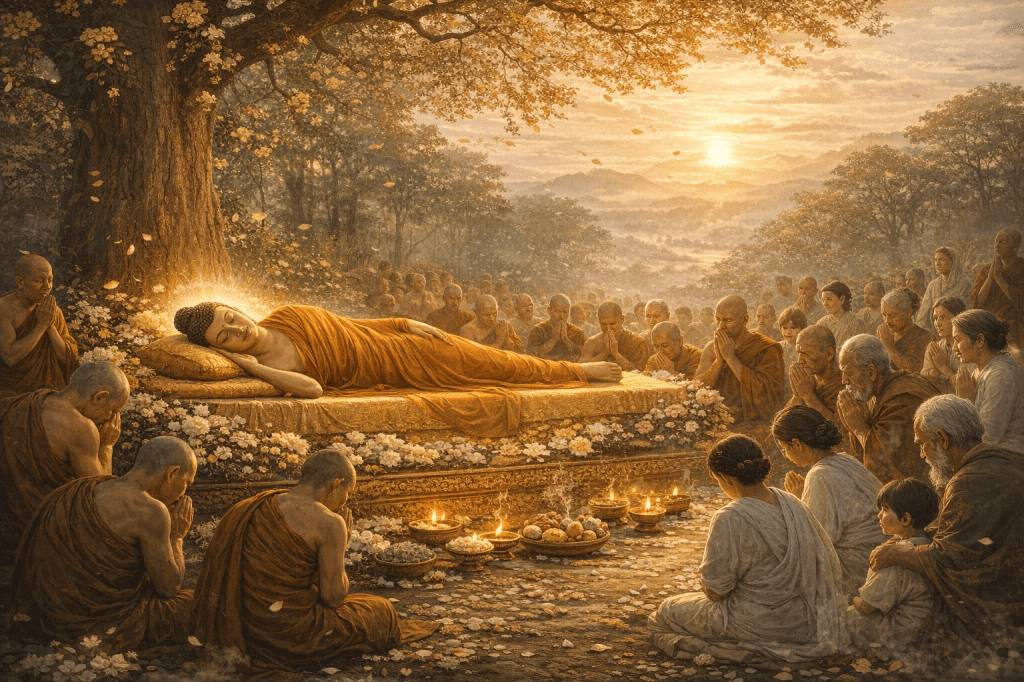
Then the Buddha said to Ānanda, “Come, Ānanda, let’s go to the far shore of the Golden River, and on to the sal forest of the Mallas at Upavattana near Kusinārā.” Known today as Kushinagar, it is a popular site for pilgrims, with many ancient stupas, Buddha images, and a peaceful park for meditation.
“Yes, sir,” Ānanda replied. And that’s where they went. Then the Buddha addressed Ānanda, “Please, Ānanda, set up a cot for me between the twin sal trees, with my head to the north. I am tired and will lie down.”
“Yes, sir,” replied Ānanda, and did as he was asked. And then the Buddha laid down in the lion’s posture—on the right side, placing one foot on top of the other—mindful and aware. Normally when the Buddha lies down, his mind is focused on getting up. But now he knows that he will not rise again.
Now at that time the twin sal trees were in full blossom with flowers out of season. Sal trees blossom in April/May. This detail agrees with the Buddha’s final extinguishment in December/January, rather than in May (Vesak) as is currently celebrated (see note to DN 16:3.9.3). They sprinkled and bestrewed the Realized One’s body in honor of the Realized One. And the flowers of the heavenly Flame Tree fell from the sky, and they too sprinkled and bestrewed the Realized One’s body in honor of the Realized One. And heavenly sandalwood powder fell from the sky, and it too sprinkled and bestrewed the Realized One’s body in honor of the Realized One. And heavenly music played in midair in honor of the Realized One. And heavenly choirs sang in midair in honor of the Realized One.
Then the Buddha pointed out to Ānanda what was happening, adding: “That’s not the full extent of how the Realized One is honored, respected, revered, venerated, and esteemed. Any monk or nun or male or female lay follower who practices in line with the teaching, practicing properly, living in line with the teaching—they honor, respect, revere, venerate, and esteem the Realized One with the highest honor. This calls back to the description of the fourfold assembly in the Māra section above (DN 16:3.7.4). So Ānanda, you should train like this: ‘We shall practice in line with the teaching, practicing properly, living in line with the teaching.’” This kind of narrative elevation is characteristic of the Buddha’s teaching. He did not try to deny or eliminate any belief in the miraculous, or in the power of devotion, but rather to show that such things were of limited worth compared with practice.
(Note: This passage emphasizes that the highest way to honor the Buddha is not through ritual offerings, but through living and practicing the Dhamma)
Dīgha Nikāya, Mahāparinibbāna Sutta (DN 16).
(II.265–266)
 НОМЫН ҮЙЛЧЛЭГЧ
Leave a comment